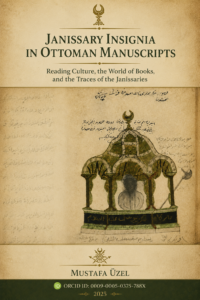
This article examines Janissary insignia in Ottoman manuscripts and their relationship to reading assemblies (kıraat), manuscript culture, and Ottoman book history.oman society
Janissary Insignia in Ottoman Manuscripts
05/2026
Public reading constituted one of the most widespread forms of social and cultural interaction in Ottoman society during the eighteenth and nineteenth centuries. Conducted in coffeehouses, private homes, and other gathering places, these reading sessions typically revolved around heroic narratives drawn from Islamic history and were performed aloud before an audience. As a bridge between oral and written culture, such practices brought together individuals from different social backgrounds while also shaping the cultural life of military communities.
This study examines Janissary insignia, marginal annotations, ownership marks, and other traces left in Ottoman manuscripts in order to investigate the participation of Janissaries in these reading practices. The evidence preserved on manuscript pages demonstrates that Janissaries were not merely military actors but also active participants in Ottoman book culture and the circulation of written knowledge.
For a broader study of Janissary symbols see Janissary Insignia
By analyzing manuscript annotations and insignia associated with Janissaries, the study explores patterns of reading, book ownership, and manuscript circulation in the Ottoman Empire. These materials provide valuable insight into the relationship between military communities and written culture, while also contributing to a broader understanding of Ottoman reading habits and collective cultural practices.
Through the combined examination of manuscript evidence, Janissary insignia, and reader annotations, the article offers a new perspective on the cultural world of the Janissaries and highlights the importance of Ottoman manuscripts as sources for the study of reading culture, book history, and everyday intellectual life in the Ottoman Empire.
Keywords: Janissary insignia, Ottoman manuscripts, Ottoman reading culture, Ottoman book culture, Janissary symbols, Janissary marginal notes, ownership marks, manuscript annotations, Ottoman manuscript culture, collective reading practices, Ottoman coffeehouse culture, book circulation, reader annotations, Ottoman cultural history, Janissaries and books, Ottoman military culture, Ottoman intellectual history, Ottoman written culture, manuscript studies, Ottoman Empire.
Selected Topics
- Janissary Insignia in Ottoman Manuscripts
- Janissaries and Reading Culture
- Janissary Reading Assemblies
- Janissary Marginal Notes and Annotations
- Janissary Ownership Marks
- Janissary Manuscript Culture
- Ottoman Kıraat Assemblies
- Ottoman Coffeehouse Culture
- Battalnāme and Janissary Identity
- Hamzanāme and Ottoman Popular Literature
- Abū Muslim Narratives and Military Culture
- Ottoman Book Culture
- Ottoman Reading Practices
- Ottoman Oral and Written Traditions
- Military Communities and Collective Memory
- Ottoman Manuscript Studies
- Ottoman Popular Religion and Storytelling
- Janissary Social Life
- Ottoman Cultural History
- Ottoman Manuscript Circulation