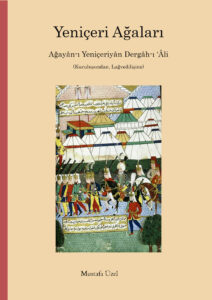
Aghas of the Janissaries
Yeniçeri Ağaları
(The Aghas of the Imperial Janissary Corps from Its Foundation to Its Abolition) (Ağayân-ı Yeniçeriyân Dergâh-ı ‘Âli Kuruluşundan Lağvedilişine)
2025 — 742 pages
Aghas of the Janissaries is a comprehensive document-based study of the aghas who administered the Janissary Corps from its foundation to its abolition. Drawing extensively on primary Ottoman sources, chronicles, manuscripts, tombstones, archival materials, and neglected historical records, the book examines the political, social, and institutional transformation of the Ottoman Empire through the history of the Janissary aghas.
Beyond military history, the study explores Ottoman political culture, palace conflicts, urban unrest, corruption networks, factional struggles among state elites, Bektashi connections, collective memory, and the gradual weakening of the Janissary institution prior to its abolition. The work also investigates public punishments, major fires in Istanbul, power struggles within the imperial administration, and the hidden mechanisms that shaped the final centuries of the Ottoman Empire.
By approaching the Janissary Corps not merely as a military institution but as a complex political, social, and symbolic structure, the book offers an alternative perspective on Ottoman modernization, centralization, and the abolition of the Janissaries.
Keywords: Janissaries, Janissary aghas, Ottoman political culture, Ottoman military elites, Ottoman modernization, Ottoman power struggles, Bektashism, Ottoman manuscripts, Ottoman social history, Ottoman urban history, Ottoman state crisis, Ottoman corruption, Ottoman collective memory, Ottoman military cultur
The Office of the Janissary Aghas
The office of the Janissary Agha (Aga-yı Yeniçeriyân-ı Dergâh-ı Âli) ranked among the highest military appointments within the Ottoman Empire. Although commonly regarded simply as the commander of the Janissary Corps, the office gradually developed into one of the most influential institutions of the Ottoman administrative system. The Janissary Agha exercised authority not only over the corps itself but also over a wide range of military, judicial, ceremonial, and public security matters, making him one of the principal officials responsible for maintaining order in the imperial capital.
The responsibilities of the Janissary Agha extended far beyond the battlefield. In addition to commanding the Janissaries during military campaigns, he supervised discipline within the corps, implemented imperial orders, participated in state ceremonies, maintained public order in Istanbul, and exercised judicial authority over members of the corps. The Agha also coordinated numerous subordinate officers, including the Sekbanbaşı, Kethüdayeri, Başçavuş, Mir-i Âlem, and many other officials who together formed the administrative hierarchy of the Janissary institution.
During the early centuries of the Ottoman Empire, the Janissary Aghas were generally selected from among experienced officers who had risen through the ranks of the corps itself. This practice reflected the military character of the institution and ensured that its commanders possessed practical experience within the Janissary organization. However, towards the end of the reign of Sultan Mehmed II, and more systematically during the reign of Sultan Bayezid II, a significant institutional reform altered this long-established tradition. Thereafter, the office increasingly came to be entrusted to palace-trained officials educated in the Enderun, rather than to officers promoted directly from within the Janissary Corps.
This administrative transformation also led to the establishment of the Agha Companies (Ağa Bölükleri) and the subsequent reorganization of the former Sekban Companies into the 65th Cemâ’at. Far from representing a punitive measure, this reform formed part of a broader restructuring of the Ottoman military administration aimed at strengthening central authority and reducing the political influence of military commanders who had previously risen through the corps.
The institutional history of the Janissary Aghas therefore reflects much more than the evolution of a military office. It offers valuable insight into the changing relationship between the Ottoman palace, the military establishment, and the mechanisms of imperial government. For this reason, the office of the Janissary Agha provides an important perspective from which to examine the broader political and administrative transformation of the Ottoman Empire.
Selected topics
- The political role of the Janissary aghas
- Ottoman palace conflicts and factional struggles
- The transformation of the Janissary Corps
- Bektashi networks and the Janissaries
- Ottoman urban unrest and crowd movements
- Corruption mechanisms within the Ottoman administration
- Public punishments and ceremonial politics
- Major fires and political crises in Istanbul
- Ottoman military and political elites
- The gradual weakening of the Janissary institution
- The abolition of the Janissary Corps
- Ottoman modernization and centralization
- Ottoman collective memory and political culture